Choosing a career path is one of the most daunting decisions a student faces. The pressure is immense: pick the “right” course, the “right” college, and the “right” profession—all while still discovering who you are. For years, career guidance relied on academic scores, societal pressure, and vague interest tests. But what if the key to a fulfilling career lies not just in what you like, but in how your brain is wired?
Enter Brain Profiling—a modern, science-backed approach that is revolutionizing career guidance by helping students understand their innate cognitive strengths and natural thinking styles.
What is Brain Profiling?
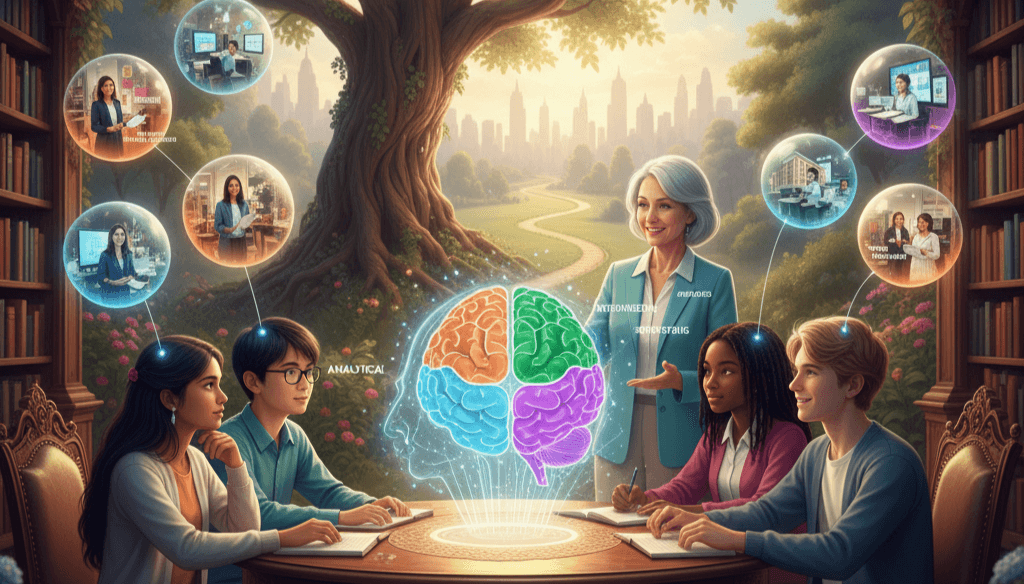
Brain profiling is an assessment methodology that maps an individual’s dominant cognitive preferences—how they naturally process information, solve problems, make decisions, and interact with the world. It’s not an IQ test. Instead, it decodes your brain’s unique “operating system.”
Popular models used in brain profiling include:
- HBDI (Herrmann Brain Dominance Instrument): Identifies your thinking preferences in four quadrants: Analytical, Organized, Interpersonal, and Strategic.
- DISC Assessment: Focuses on behavioral styles: Dominance, Influence, Steadiness, and Conscientiousness.
- Neuro-Linguistic Programming (NLP) Models: Understand how you filter information through visual, auditory, or kinesthetic preferences.
These tools move beyond what you know to uncover how you think best.
The Problem with Traditional Career Choices
Many students end up in careers that feel mismatched because traditional methods have critical flaws:
- The “Marks-Driven” Trap: Just because you score well in Biology doesn’t automatically mean you’ll enjoy being a surgeon. The skills required for the
- job (steady hands, high-pressure decision-making) may not align with your cognitive preferences.
- The “Parental Pressure” Pitfall: Choosing a career to fulfill someone else’s dream often leads to burnout and dissatisfaction.
- The “Trendy Career” Misstep: Picking a field just because it’s popular (like everyone choosing IT in the 2000s) ignores individual aptitude.
This mismatch is why we see so many professionals feeling stuck, unfulfilled, and questioning their path years into a career.
How Brain Profiling Guides Students to the Right Fit
Brain profiling acts as an internal compass. Here’s how it works in practice:
1. It Identifies Innate Strengths, Not Just Learned Skills
A student might be good at mathematics because they’ve practiced diligently, but their brain profile might reveal a dominant interpersonal preference. This suggests a career like clinical psychology, management, or teaching—where they can use math as a tool while engaging their core strength of understanding people—would be more fulfilling than pure theoretical research.
2. It Clarifies Optimal Work Environments
Your brain’s wiring determines where you thrive.
- An Analytical/Logical profile might excel in data-science labs, engineering firms, or forensic research—environments that value precision and objectivity.
- A Strategic/Imaginative profile might suffocate in rigid, repetitive jobs and instead bloom in careers like entrepreneurship, advertising, or strategic consulting, where big-picture thinking and innovation are prized.
- An Organized/Sequential thinker is the backbone of project management, logistics, or financial planning, ensuring structure and processes run smoothly.
3. It Reduces Anxiety and Boosts Confidence
The uncertainty of “What should I do with my life?” is a huge stressor. Brain profiling provides clarity and validation. When a student sees that their profile aligns with
successful professionals in a certain field, it replaces doubt with confidence. They understand their choices are not random but rooted in their own cognitive blueprint.
4. It Expands Horizons Beyond Obvious Careers
A student who loves art might only consider being a painter. But a brain profile might reveal strong strategic and interpersonal quadrants, suggesting perfect aptitude for art therapy, museum curation, user experience (UX) design, or creative direction—blending their love for art with their natural thinking style for broader career opportunities.
Real-World Application: A Student’s Journey
Priya, a Class 11 student, was conflicted. She loved debating (suggesting law), was good at biology (suggesting medicine), and enjoyed writing. Pressure from family pushed her toward medicine, but she felt hesitant.
Her Brain Profile (HBDI) revealed: High in Interpersonal (understanding people, communication) and Strategic (big-picture ideas), with moderate Analytical.
The Insight: While Priya had the analytical ability for medicine, her highest drivers were communication and big-picture strategy. The day-to-day details of a medical practice might not satisfy her.
The Career Match: Careers that merged her strengths were proposed: Healthcare Law, Medical Journalism, Public Health Policy, or Clinical Psychology. These paths would use her understanding of science while engaging her core strengths in communication and strategy. Priya felt a wave of relief and direction—she is now exploring Public Health degrees.
Conclusion: From Confusion to Clarity
Choosing a career is no longer a shot in the dark. Brain profiling provides a scientific, personalized framework that empowers students to make informed, confident decisions. It shifts the question from “What career should I choose?” to the more powerful “Who am I, and what environments will make my unique mind thrive?”
By understanding their own cognitive blueprint, students can step out of the maze of confusion and onto a path that doesn’t just promise success, but ensures alignment, engagement, and long-term fulfillment.
Your brain holds the blueprint to your potential. It’s time to start reading it.